
The National Energy and Utilities Regulatory Commission of Ukraine (NEURC) has updated the rules governing active consumers — residential or business clients who simultaneously purchase electricity from the grid and export their own generation surplus back into it. The changes affect two key market documents and clarify which generation sources are permitted, how the supplier purchases surplus volumes, and what documentation is required to conclude a contract.
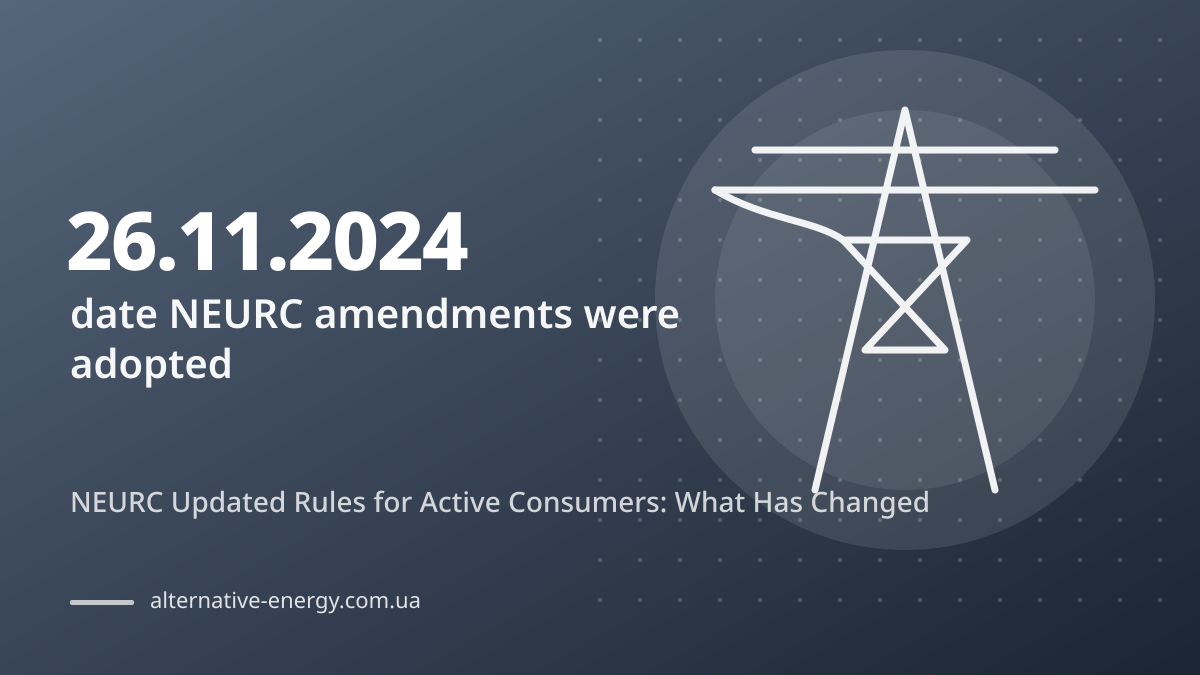
According to NEURC, the decision was adopted on 26 November 2024 at a regulatory session. Amendments were introduced to the Retail Electricity Market Rules (NEURC Resolution No. 312 of 14.03.2018) and the Procedure for the Sale, Metering and Settlement of Electricity Generated by Active Consumers (NEURC Resolution No. 2651 of 29.12.2023). The updates align both instruments with Ukrainian Law No. 3915-IX on energy sector terminology.
In brief:
- Gas and cogeneration units have been added to the list of permitted generation sources for active consumers — alongside renewable energy sources.
- If the permitted export capacity is exceeded in any given hour, the supplier is obliged to purchase the full volume fed into the grid during that hour, minus the cost of the excess.
- To conclude a self-generation contract, a residential customer with an existing supply agreement need only submit the metering point passport with a note on the generating unit and a bank statement confirming the account for payments.
- Suppliers are no longer entitled to compensation for deviations of ordinary (non-active) consumers from contracted consumption volumes.
Permitted Sources: From Renewables to Gas and Cogeneration
The revised wording broadens the scope: NEURC has confirmed the right of consumers to connect generating units not only from alternative (renewable) energy sources but also from others — gas, cogeneration, and similar. The ongoing operation of such units is formalised under the self-generation mechanism.
For households already operating under the feed-in tariff, the procedure for amending the electricity purchase agreement with the universal service supplier has been separately simplified. The process is eased for cases involving technical re-equipment of a generating unit with an increase in its installed capacity and reconstruction of the metering node. For more on current conditions for exporting household generation, see the article on the new feed-in tariff time windows for residential solar power plants.
Excess Settlement and a Simplified Document Package
Active consumers are subject to a cap on the capacity they are permitted to export to the grid. The new rules clarify what happens when this limit is momentarily exceeded within a given hour. In that case, the electricity supplier is obliged to purchase the entire volume of electricity fed into the grid during that hour, minus the cost of the excess.
The logic is straightforward: the customer does not lose payment for the compliant portion of the export, but the surplus above the permitted threshold is settled under a different formula — by deducting its value from the total amount due for that hour. This approach closes the grey area that previously existed due to the absence of a clear algorithm for suppliers to follow whenever the cap was breached.
At the same time, NEURC has reduced the documentation package. If a residential customer already has a valid electricity supply contract, to conclude a self-generation contract they need to submit only:
- the metering point passport with a note on the generating unit;
- a bank statement confirming the account to which payments for exported electricity will be credited.
One document confirms the technical parameters of the metering point and the presence of generation equipment; the other provides payment details. Everything else the supplier already holds from the existing supply contract.
What Changes for Suppliers
The key change for suppliers is the removal of the right to compensation for consumer deviations from contracted consumption volumes and capacity. This applies to customers who are not active consumers. The mechanism that previously allowed suppliers to shift part of their balancing risks onto ordinary customers is no longer available under the new rules.
At the same time, the universal service supplier is now permitted to apply two prices simultaneously in its commercial offer — one for residential use and one for non-residential use. This creates scope for contractual arrangements with a residential customer who consumes part of their electricity for non-residential purposes — for example, in a flat that also serves as a client reception office or a home workshop. This distinction ties the price to the actual end use of the electricity rather than solely to the customer category.
What the Changes Mean for the Market and Consumers
The updates move the self-generation model towards more transparent conditions: the active consumer becomes a full participant in the retail electricity market, with clear export rules and a lower barrier to entry. The expansion of permitted sources is a signal to businesses with gas and cogeneration assets that their units can also be integrated into a self-supply scheme — not only into wholesale market mechanisms. For residential solar power plant owners, the most practical gain is a leaner paperwork requirement to get started and a clear procedure for upgrades under the feed-in tariff.
If you are planning to become an active consumer, it is worth checking with your supplier before signing the contract exactly how an hour with an export cap exceedance is calculated, and making sure your metering point passport includes a note on your generating unit. The regulator’s overall approach fits within a broader drive toward flexible consumption — including rewards for load controllability that NEURC is introducing in parallel.
Sources: НКРЕКП
Prepared by the Alternative Energy editorial team with the help of AI based on the sources listed; facts and figures were checked against them during automated editorial review. How we prepare articles


