


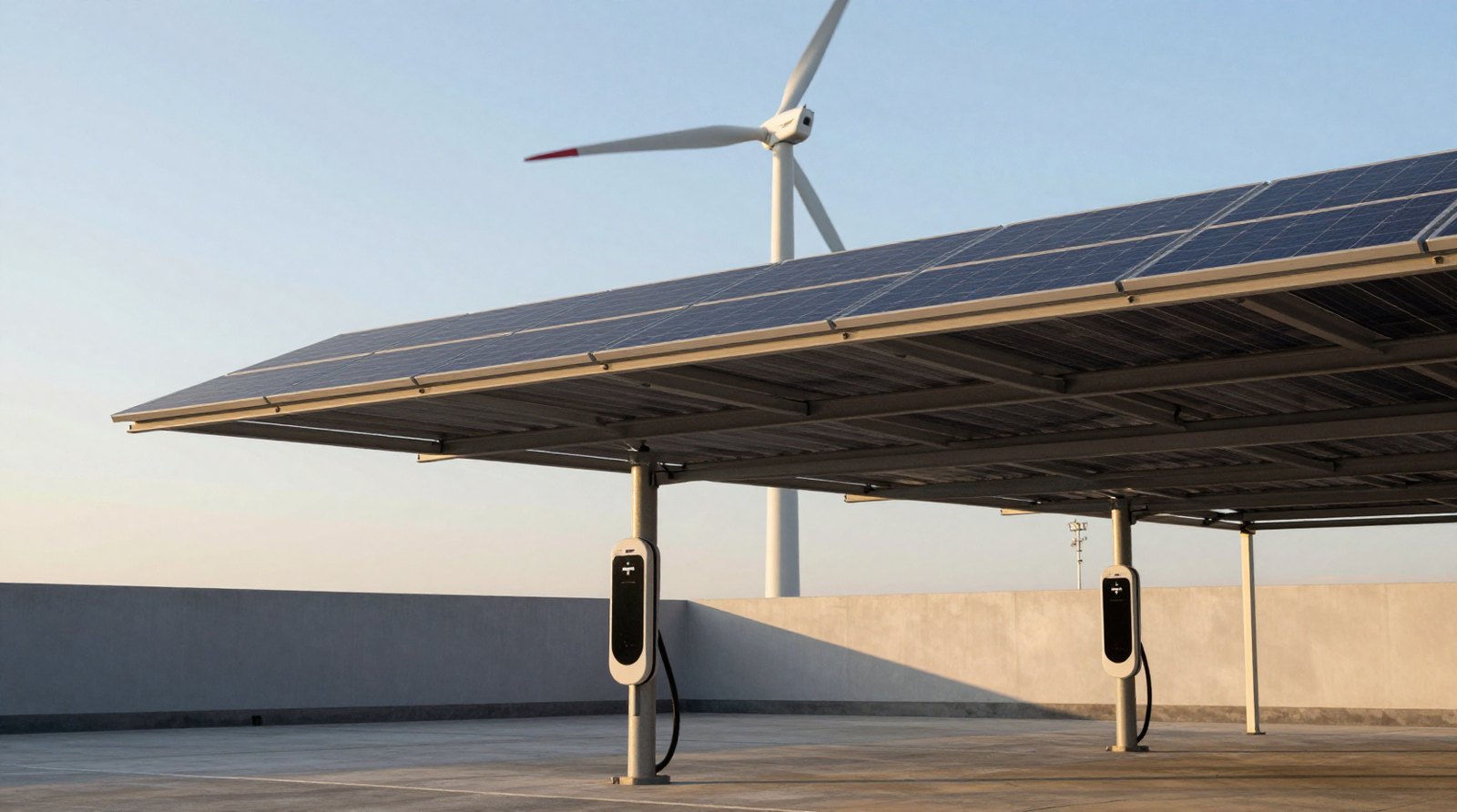
When EV owners plan to charge from their own solar installation, the first question is whether panels alone will suffice, or whether a battery is needed — and in some cases a wind turbine too. A new peer-reviewed study in Scientific Reports answers that with concrete figures: the optimal configuration was calculated for 26 locations, and there is no universal formula for solar EV charging.
Key findings:
- For 11 of 26 locations (42%), the optimum is the full hybrid “solar + wind + battery.”
- For the remaining 15 locations, “solar + battery” without a wind turbine wins.
- The “wind + battery” configuration without PV proved unviable at every location.
- Combined annual CO₂ reduction across all 26 stations: 19,872,700 kg.
What the researchers did
The paper “Techno-economic and policy analysis of solar-wind powered EV charging for sustainable E-mobility” was published in Scientific Reports (Nature Portfolio) on 30 April 2026. The authors selected 26 locations across India with varying climates and, for each, compared several charging station configurations: PV with battery only, wind with battery only, full hybrid, and variants with different power electronics. Evaluation criteria were cost of energy (COE), net present value, and initial capital cost.
Three charging scenarios — and the winner
In the first scenario — the full hybrid “PV + wind + battery” — Bhopal showed the best economics and Pune the worst. This configuration proved optimal for 11 locations. In the second scenario — “PV + battery” without wind — the solar-rich station in Jodhpur led with a COE of ₹33.39/kWh, while overcast conditions in Srinagar produced the weakest result. For sunny regions, the lower COE bound was fixed at ₹33.39/kWh, whereas under cloudy conditions the figure reached ₹446/kWh. The third scenario — “wind + battery” without solar panels — was not viable at any of the 26 locations: the cost of generated energy was simply too high.

When high load undermines the economics
The sensitivity analysis revealed another important pattern. When EV load grows faster than generation capacity, the system becomes less reliable. Conversely, when charging power is balanced against available solar and wind resources, both economics and operational stability improve. This is a direct warning for anyone planning to add several fast chargers to an existing solar power plant without recalculating capacity and battery storage volume.
What this means in practice
A direct mapping of Indian figures to local tariffs does not work: both the cost of solar energy and wind resources differ. But the core methodological conclusion transfers well. Where wind resources are inconsistent — which is typical for most regions — solar-plus-battery configurations become the natural choice. Two practical takeaways stand out. First: do not cut corners on battery storage — it is what ensures charging stability when the grid is unavailable. Second: before sizing a system, assess the local solar and wind resource rather than copying a setup from an online forum. If the site has consistent wind, it is worth considering adding a wind turbine to the solar power plant, since that hybrid performed best in nearly half of all studied locations.
Sources: Scientific Reports (Nature Portfolio)
Illustration generated with AI
Prepared by the Alternative Energy editorial team with the help of AI based on the sources listed; facts and figures were checked against them during automated editorial review. How we prepare articles


