


South Korean researchers have demonstrated how to eliminate lithium from perovskite solar cells without sacrificing performance. The work from the Korea Institute of Energy Research (KIER) directly addresses one of the technology’s main barriers to commercialization: premature module degradation during operation.
Key findings:
- Power conversion efficiency — 25.24% versus 25.21% with the standard process.
- 95% of initial efficiency retained after 1,000 hours of operation.
- Testing conducted under harsh conditions: 85°C and 85% relative humidity.
- Nickel oxide (NiOx) used as a catalyst, followed by filtration.
Why Lithium Undermines Perovskite Longevity
According to techxplore.com, during operation these substances evaporate, creating voids and defects between layers that reduce module lifespan. As temperature and humidity rise, lithium ions migrate uncontrollably through the structure, accelerating degradation.
For a technology that has historically trailed silicon in stability, this has been a serious obstacle.
How KIER’s Team Purifies the Structure
Scientists from the Photovoltaic Research Department at KIER, working alongside a team led by Professor Dong Suk Kim at UNIST (Ulsan National Institute of Science and Technology), developed a two-step process. Nickel oxide is introduced into the solution used to form the hole transport layer, where it acts as a catalyst by binding lithium ions. The mixture is then filtered, removing the catalyst along with the captured lithium.
The resulting charge-transport layer is free of lithium impurities — and therefore free of the evaporation and diffusion that cause cell degradation.

What the Measurements Showed
Cells without lithium additives achieved an efficiency of 25.24%. For comparison, a sample produced by the standard process reached 25.21%. The purification step not only avoided any efficiency penalty — it delivered a small but consistent gain.
The more significant result is in longevity. Under accelerated aging conditions of 85°C and 85% relative humidity, the purified cells retained 95% of their initial efficiency after 1,000 hours. For perovskite cells, this represents a meaningful step forward.
The study was published in Advanced Science (DOI: 10.1002/advs.202521825). Rather than stabilizing lithium within the structure, the team chose to remove it entirely — what lead researcher Ahn describes as moving beyond conventional approaches — through catalysis and filtration. The authors note that no comparable strategies had previously been proposed.
What This Means for the Perovskite Market
Chemical instability and short operational life have until recently been the primary arguments against deploying perovskite modules in commercial projects. If KIER’s approach can be reproduced by other laboratories and eventually scaled to production lines, one of the technology’s most fundamental criticisms is addressed. For companies tracking the next generation of solar cells — including tin-based perovskites and related approaches — this is a signal to regard perovskites as serious candidates for real-world power generation, not just subjects of laboratory experiments. The team’s next publications will be worth watching closely, particularly data from larger-area samples and full-size modules.
Sources: techxplore.com
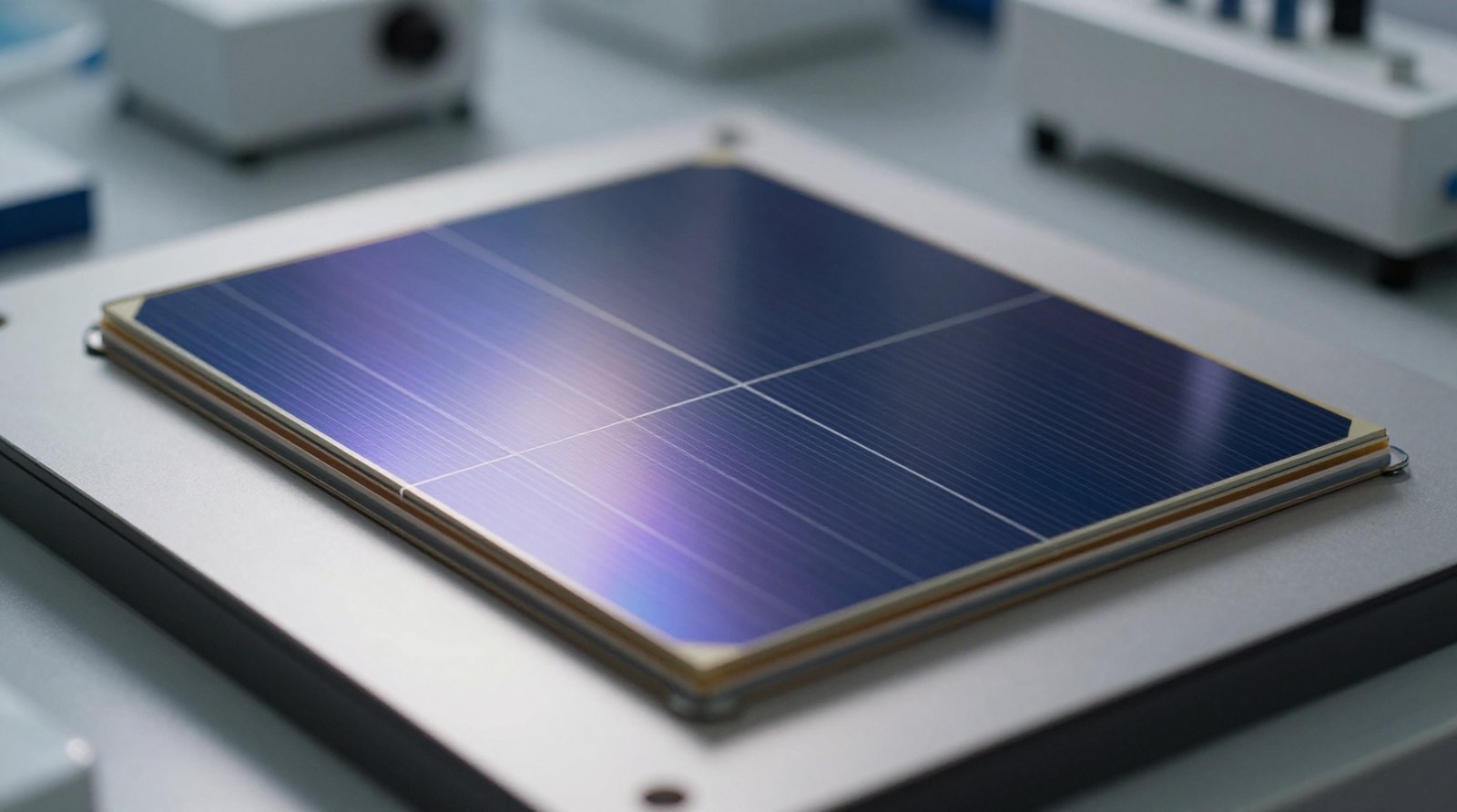
Illustration generated with AI
Prepared by the Alternative Energy editorial team with the help of AI based on the sources listed; facts and figures were checked against them during automated editorial review. How we prepare articles


