


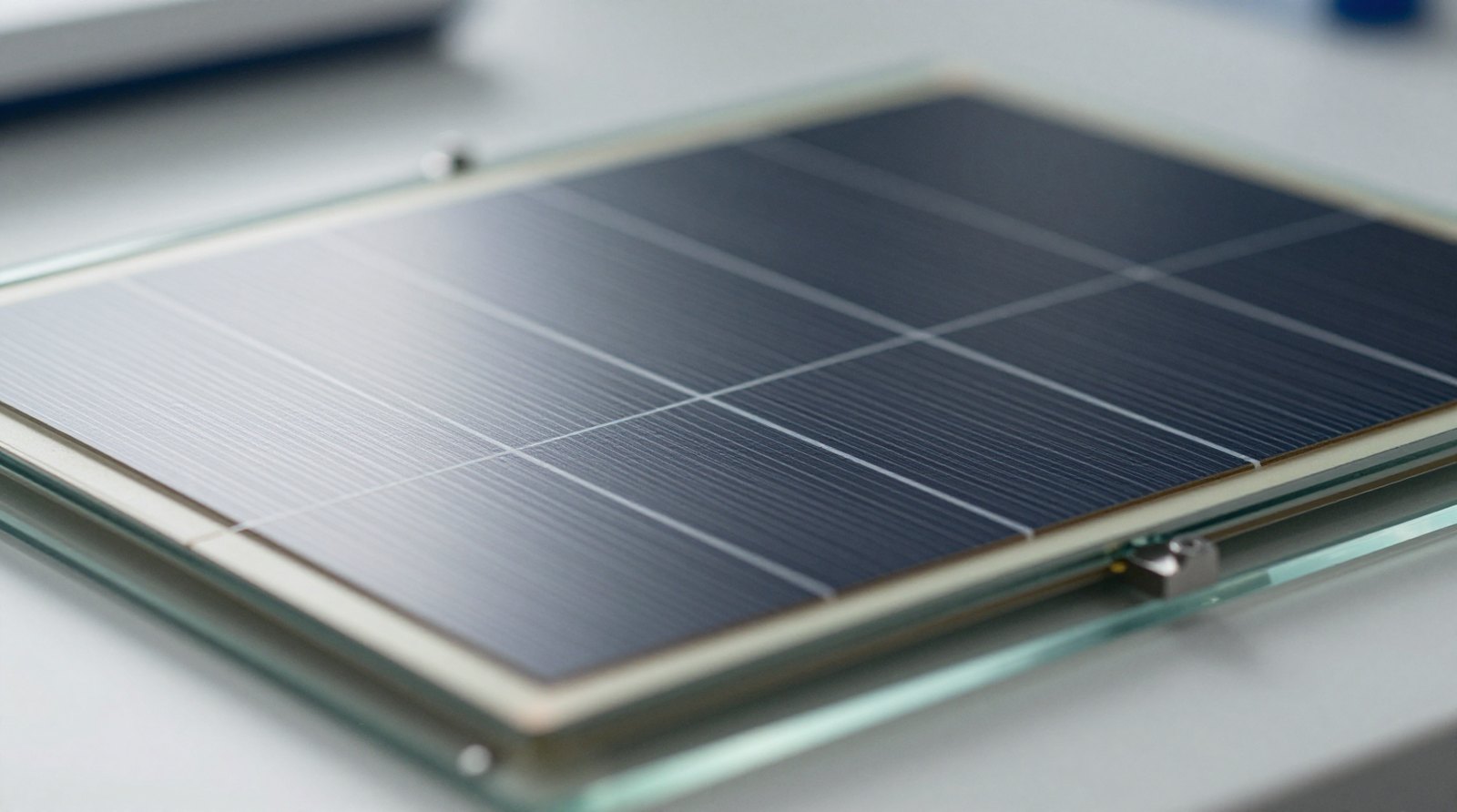
A team led by researchers at the University of California San Diego (UC San Diego) has demonstrated how perovskite solar cells can be made both more efficient and more stable at the same time. The approach involves adding a special mixture to the perovskite precursor solution — one that briefly becomes a liquid during crystallization, helps grow higher-quality crystals, and then disappears, leaving behind a material with fewer defects.
At a glance:
- The additive is a mixture of zinc bromide (ZnBr₂) and methylammonium chloride (MACl) that forms a temporary eutectic liquid.
- The crystal growth mechanism is described as “solid → liquid → solid.”
- Perovskite solar cells and LEDs achieved efficiencies of 24–26%.
- Devices retained most of their initial efficiency after 8 weeks of continuous operation under simulated sunlight.
How the “disappearing” liquid works
Perovskites are a promising class of semiconductors that can be deposited from solution as thin films.
According to techxplore.com, the researchers added a ZnBr₂ and MACl mixture to the perovskite precursor. Upon heating, this mixture forms a eutectic that temporarily transitions into a liquid phase. Within that liquid phase, perovskite crystals grow larger and more uniform, with fewer structural defects. The methylammonium chloride then evaporates, while zinc concentrates at grain boundaries — precisely where electronic traps would otherwise form.
The researchers describe the overall mechanism as “solid-liquid-solid”: solid → liquid → solid. It was confirmed using advanced X-ray imaging techniques.
“We’re introducing a new way to control the growth of halide perovskites through an additive that actively changes during crystallization. And the coolest part is that the end product cleans up the defects that limit performance,” — Connor Dolan, PhD graduate from David Fenning’s lab at UC San Diego.

What the measurements showed
Perovskite solar cells and LEDs fabricated using the new method demonstrated efficiencies ranging from 24% to 26%.
The authors also report a separate record: the material exhibited the longest-lived electron-hole pairs ever reported for any direct-bandgap semiconductor. For solar energy, this means that charge carriers generated by light survive longer before recombining — and a greater fraction of them contribute to usable current.
The team also notes that the method worked across different perovskite compositions they tested. The work was published in Science (DOI: 10.1126/science.aeb4554) in collaboration with Princeton University and Sungkyunkwan University; the first author is Jason J. Yoo.
“It felt like everything we tried just worked. I’m hopeful that this mechanism could turn out to be truly generalizable,” — Connor Dolan.
Why this matters for solar energy
Two of the main barriers holding perovskites back from commercial manufacturing are reproducibility — crystals grow differently from sample to sample — and long-term stability. The proposed approach addresses both simultaneously: the eutectic liquid promotes more uniform films, while residual zinc at grain boundaries neutralizes defects.
For the industry, this is an argument for looking more closely at additive chemistry as a path to growing better perovskites without complicating the equipment. If the mechanism proves genuinely universal, it could be transferred to perovskite/silicon tandem cells, where the perovskite top cell is responsible for pushing efficiency further. Those tracking other approaches to efficiency gains will find useful context in our article on organic solar cells.
For now, these are laboratory results published in Science, not a finished industrial process. But the fact that the liquid phase exists only temporarily and leaves behind chemistry that is actually beneficial to the material is an elegant engineering insight — one that could well simplify the path from perovskite research to mass-produced solar panels.
Sources: techxplore.com, Science (DOI)
Illustration generated with AI
Prepared by the Alternative Energy editorial team with the help of AI based on the sources listed; facts and figures were checked against them during automated editorial review. How we prepare articles


