


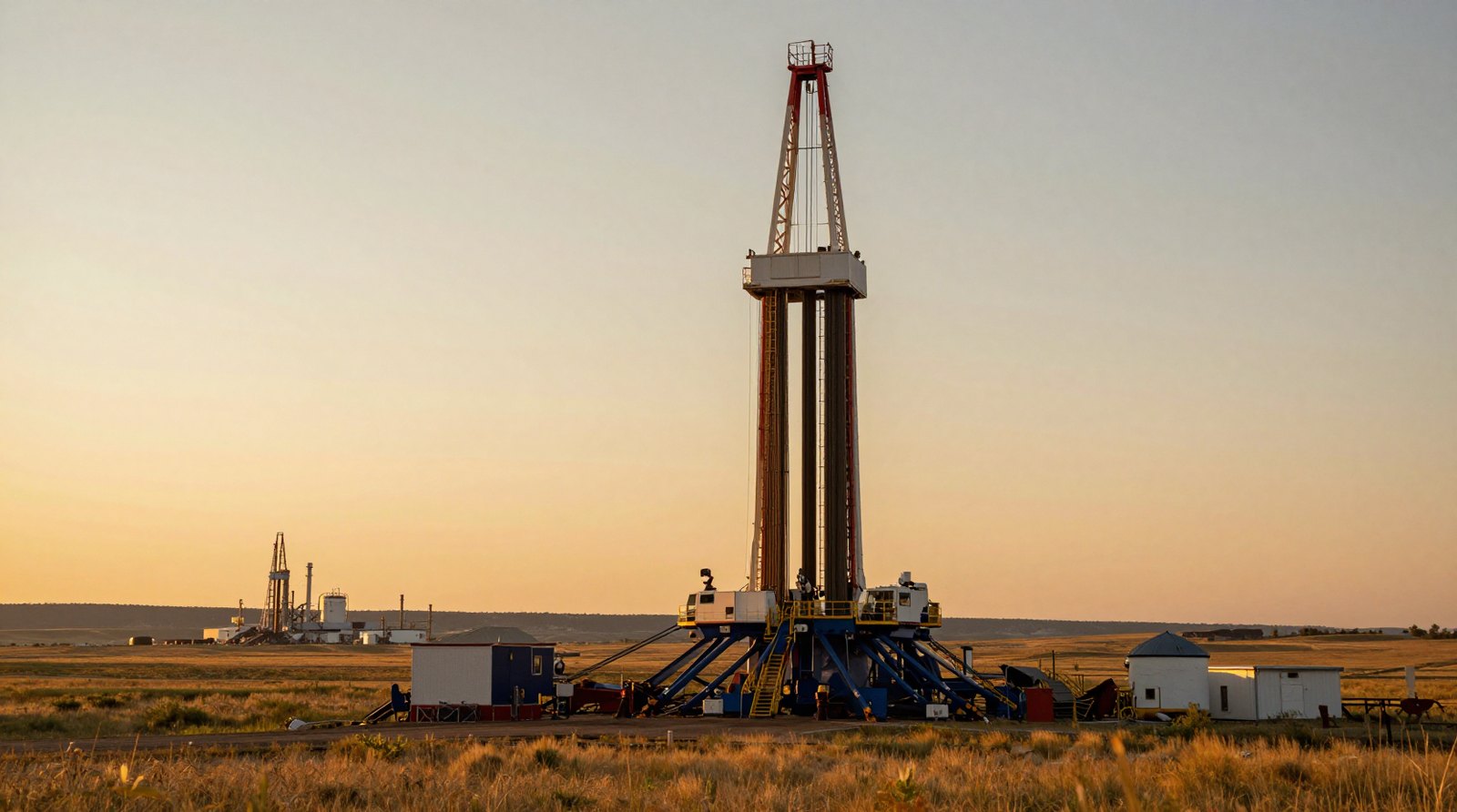
American oil company Occidental Petroleum (Oxy) has drilled a deep geothermal well in Colorado — one of the deepest ever sunk in the United States for the purpose of extracting heat from the earth. This project has nothing to do with oil or gas: the goal is to tap into clean subsurface heat for a future power plant.
Key facts:
- Depth — approximately 6.5 km (20,000 ft), one of the deepest geothermal wells in Colorado.
- One of the two wells was drilled in a record 18 days.
- Expected bottom-hole temperature — above 230°C (450°F).
- Funding — a $9 million US Department of Energy grant under the GLADE program.
What Oxy Did in Weld County
According to Canary Media, in April 2025 Occidental Petroleum began drilling at a site adjacent to a gas processing plant south of Greeley in Weld County. The region is no stranger to rigs — it produces the bulk of Colorado’s oil and gas. But this time the derrick went up for a different reason: in under six weeks, the company drilled two wells to roughly 6.5 km each.
The project is called GLADE — Geothermal Limitless Approach to Drilling Efficiencies. In 2022, the US Department of Energy awarded it a $9 million grant. The objective is to determine whether modern drilling techniques can reach ultra-deep hot rock faster and more cheaply than before. A national laboratory assessment puts the site’s potential capacity at 2.2 MW.
Why Drilling Speed Matters
Ultra-deep geothermal wells have traditionally been slow and expensive to complete. Oxy reported that its project set new “drilling milestones” for the state of Colorado: one well was finished in 18 days using oil-and-gas drilling techniques. That is a significant achievement — the economics of deep geothermal energy hinge largely on drilling time and cost.
Temperatures at the bottom are expected to exceed 230°C. Under Oxy’s concept, the two wells can be connected through additional drilling or hydraulic fracturing of the rock between them. The resulting underground loop would heat a working fluid that drives a turbine at the surface.
Oil and Gas as a Driver of Geothermal Development
For over a century, geothermal power plants were built almost exclusively where heat sits close to the surface — near hot springs or zones of volcanic activity, such as Iceland or California’s The Geysers region. A similar logic applies to the story of dormant volcano geology as an energy source: without favorable geological conditions, reaching that energy is simply too expensive.
Canary Media, citing the International Energy Agency, notes that geothermal currently supplies less than 1% of global electricity demand. Yet the IEA estimates the resource could meet that demand 140 times over — if the industry learns to drill deep efficiently. That is precisely where oil and gas companies, with their rigs, crews, and hydraulic fracturing expertise, could play a decisive role.
“It’s very encouraging to see an oil company actually pick up a drill bit rather than just standing on the sidelines and thinking about it,” said Roland Horne, professor of Earth sciences and director of the Stanford Geothermal Program.
What This Means for the Broader Oil and Gas Sector
The GLADE project sends a clear signal to operators that already own deep-drilling rigs, skilled crews, and the logistics to match: those same capabilities can be redirected toward heat extraction. For oil and gas companies operating in mature basins with aging infrastructure, it is an argument to keep a close eye on the long-term potential of deep geothermal energy. If further GLADE testing validates the economics, a deep geothermal well could graduate from an experimental format into a practical baseload tool for the power grid.
Sources: Canary Media
Illustration generated with AI
Prepared by the Alternative Energy editorial team with the help of AI based on the sources listed; facts and figures were checked against them during automated editorial review. How we prepare articles


